Everyone can benefit from mentoring, but have you tried the alternative?
Theirishscouter has been fortunate in having had some impressive and generous mentors in life to date, both in career but also in Scouting.
Seasoned figures with vast banks of experience, who have offered sage advice. Sometimes, these figures have gently curbed the odd excess or tendency towards ill-judged actions. In one’s earlier days, these potential excesses are often driven by inexperience. Later, the odd bout of cynicism or a desire to rock the boat a little too much can sometimes benefit from a quiet word.
A mentor can play a central role in one’s life. More commonly, they are the person around who’s kitchen table you pace, late at night as you work through a problem – often one of one’s own making. They might be your hiking companion, labouring up hills and skirting rivers whilst you huff out your problems as they gasp back thoughts on how to solve them.
Of course, as one moves through life, many of those rough corners get smoothed out by life itself; the experiences, errors of judgement, mistakes and ‘seemed like a good idea at the time’ ideas that upon mature reflection, never quite seem worth repeating.
We all probably learn far more from our mistakes than from our successes. A mentor however can guide us though difficult patches, new challenges and sticky situations we have not encountered previously.
The tendency to look upwards in age range for a mentor is entirely understandable. After all, is it not experience one seeks when inviting a mentor into one’s deliberations?
Theirishscouter realized a few years back that mentors in fact come in all shapes and sizes – they also come sometimes with surprising age profiles.
As a scouter, most of us come into contact not just with inspirational elders on the Scouting trail, but plenty of younger people who can also inspire. Theirishscouter learned early on (as no doubt some readers did), that seeking and listening to advice from a young person can provide a lot of value.
Interaction with water provides an example. A few years back, a highly energetic toddler from the offspring collection took off in a pool towards the deep end. Theirishscouter’s general view on water has always been that it is palatable to drink and acceptable to wash in, but that’s about all the interaction required.
As a side note, when Scouting Ireland formed, the pre-uniform period was a bit of a free for all and theirishscouter could not resist getting hold of an SAI shirt to wear at NMC meetings, just to irk the elders – not the mentors; the ‘old boys’ club (the mentors approved!). It also afforded an opportunity to wear a Sea Scout jumper (as vastly preferable to wearing a shirt, but not credible for a land lubber prior to this…)
In any event, as junior went ever further into the deep end, merrily suggesting I follow him, I did precisely that. He is now eleven and theirishscouter, whilst not a strong swimmer, is infinitely more comfortable in water – a great example of exiting the comfort zone at the invitation of a younger mentor. My Dad had tried to get me swimming when I was in Beaver Scouts, and no amount of bribery would get me anywhere NEAR water…
Whilst Scouters of course can often get away with er, supervising some of the more active pursuits in Scouting, when one has offspring there is usually an expectation of full and enthusiastic participation, be it zip lining, white water rafting, snorkelling or clambering into a roller coaster. It is not mentoring in the conventional sense, but it does re-frame thought processes and create the conditions for trying new things.
As children become tweens and then teenagers, it is a mark of respect to treat them and their views with ever greater seriousness. All opinions count, but listening carefully to teens, following their line of argument and acting on it as much as possible builds a strong relationship. It also throws up some great insights.
Of course, outside the family and beyond Scouting, the idea of seeking ideas and advice from younger people works too. Theirishscouter retains a network of mentors in the world of business, but these days some of these people are starting out in their careers or are a few years less advanced on the career curve.
There is a great opportunity for exchange of advice in these circumstances, with timeless challenges solved for the younger person by the sage advice of the worldly executive, whilst the grizzled elder can get great insights and ideas from the Young Turk on topics around new technology and new ways of working.
Theirishscouter would advise everyone to consider adding a new mentor to their line up over the summer, be it an elder or younger (or both). Why not BE a mentor to someone too – you might find yourself lending some ideas or methods to someone who will be quoting you in years to come to another generation.
*Theirishscouter normally does not publish two articles in rapid succession, however there is a bit of a backlog of positive pieces that keep getting held up by media stories, hence the desire to publish something quick, just in case!
The recent announcement by Scouting Ireland that it will run some pilot groups to explore the viability of introducing Scouting to children below the age of six, highlights a few interesting things.
Theirishscouter will immediately signal an interest here in that I have for some time thought such a move could have merit, especially given other large youth-focused entities in Ireland, have long been accessible to young people from the age of three or four.
Indeed, theirishscouter was a beneficiary of an earlier trial of this type when joining one of the first CBSI Beaver Colonies during a similar trial period, (sometime back in the er, mid seventeenth century…)
In a pre-2018 Scouting Ireland (the democratic one, where the members were in charge), this sort of initiative would have (and did) run into all sorts of complications, delays and resistance. Democracy, as Winston Churchill once said (I’m paraphrasing) “is the worst form of governance” * (he said ‘government’).
The truth is, a system with limited democracy can sometimes drive forward major projects and initiatives that might otherwise take years or worse, never get off the ground. This sort of thing needs leadership with vision and who can articulate that vision and bring people with them – something we’ve had a conspicuous paucity of in recent times.
Scouting has long fretted about the relative popularity of Beaver and Cub Scouts, yet Venture Scouts has been a niche pursuit for decades and Scouts increasingly punches below its weight in the age range nationally. Rover Scouts has always been tiny and is largely dependent on finding enthusiastic proponents in a group, whose profile is frequently if not always quite different to the volunteers in the other programme sections.
The ever-decreasing membership as people advance through the programme is hardly a surprise given each latter tends to be a sub-set of the former. The number of people joining ‘off the street’ as opposed to through section transfer shrinks dramatically after the Beaver to Cub link. Younger children participate in a vast array of pursuits. This reduces dramatically once second level schooling commences for a variety of complex reasons. The bottom line however is Scouting has traditionally struggled with Cubs to Scouts retention in anything like the numbers needed.
(At less than 1% of the population, one could argue that Scouting itself is a niche pursuit. The GAA whilst suffering an existential crisis currently with membership contracting sharply, can still claim over 6% of the nation’s adults as volunteers and an overall membership of 10.4% of the total population. A very different entity in many ways, but in terms of community penetration somewhat comparable)
The fact is Beaver and Cub Scouts are quite profitable for Scouting Ireland and for Scout Groups. They pay the same fees as the older sections, yet the outlay is lower. Less risk, lower insurance, lower program costs, cheaper activities. Equally, the commitment required of adult leaders is less. (Beaver Scout and Cub Scout leaders may of course disagree – as someone who has worked in all the sections over the years, I currently love my involvement in Cubs, precisely because it is far less demanding of me. My brief sojourn into Beaver Scouts in an adult capacity during Covid in Ireland was equally a dream in terms of work/life balance).
Contrast this with Scouts, for example. Vast amounts of equipment are required, with all the logistics that entails. Scout Leaders, if they are doing the job properly (and let’s face it most scout leaders do not know how) must strike a balance between being always present – a huge time commitment, yet discreet in their leadership. If a scout troop is not being completely run by the scouts themselves, it is not a fully functioning scout troop. Yet, to ensure this happens requires a special type of adult presence and vision which is intense and time-consuming. Scouts are often a financial drain on the group. Everything costs a fortune. Return on investment is negligible. Parents of members are often somewhat distant, distracted, disinterested.
Summer camp can gobble up half of an adult volunteer’s annual leave. A major ask of anyone. A near impossibility for someone with their own kids.
Venture and Rover Scouts (apologies for lumping these two together) are if anything, even less productive. Getting activities organised is like trying to draw blood out of a stone. The members are permanently skint. They lie around the scout den, leaving a trail of dirty coffee cups and Trangias from last month’s camping trip that have yet to be scrubbed. The sofas are moth-eaten and the uniforms are crumpled and ill-fitting, if anyone can be bothered to wear them.
Theirishscouter recalls doing Group Leader training some years back and various illustrious participants loudly proclaiming their distaste of Venture scouts and their simultaneous affection for the profit margins of the Beaver colony.
To a corporate mindset (and Scouting is a corporate entity these days, not an association), Beavers, Cubs and a younger cohort of say four-to-six-year old’s is the way forward. A tidal wave of cash and not a whole lot of work involved. It makes perfect business sense, even with the risks of undermining the brand essence of Scouting.
And before everyone chokes on their tea, there is of course, an alternative view…
I don’t think it betrays any confidence to say that it is well understood in the food & beverage business globally (a significant part of theirishscouters day job), that supermarkets are not very profitable if you are a food brand. They are high maintenance. They demand constant promotions, supports, listing fees, display units, merchandisers. They want to return unsold goods, they want frequent deliveries and they offer lower margins. Why would anyone want to deal?
The answer of course is complex, but for a branded business it is about ‘presence’ in the market. A local independent store gives a better return per kg/litre, but can it offer the volume, shelf space and exposure to thousands of buyers that a chain of hypermarkets delivers?
Supermarkets deliver high volume, drive market share and build brands. I would argue Scouting’s credibility (or potential for credibility) comes from the older sections.
Yes, the older sections in Scouting are more complex and tend to be more expensive. Beaver Scouts are thrilled to visit the local park. Venture Scouts will roll their eyes at anything less than a month-long safari in the Serengeti. However, the impact that Scouting has on communities grows exponentially as its members mature.
It is endearing to see a bunch of six-year-olds clogging up the top deck of the bus or scuttling around the local woods, with harassed, albeit good-natured looking adults in hapless pursuit. It is arguably even more impactful when a group of moody teens are seen out cleaning a stretch of river or canoeing down it or out hiking or fundraising for a good cause.
The appearances of tweens and teens doing good (or just doing stuff together) in the local community of course goes far beyond aesthetics. The positive impact on each individual is incalculable and it contributes immeasurably to wider society in the shape of decent, kind, balanced responsible citizens with integrity and a keen appreciation of the out of doors, the environment and each other.
Holding on to more youth members for longer has positive organisational implications too. There is a reason the big four accounting firms hire vast numbers of energetic, enthusiastic and clever people straight out of universities. They work them hard for three years, show them how the world of business operates. Then they keep those deemed the very best fit. All the others are snapped up by the wider business community, with not just a strong grounding in business acumen. These former employees are also advocates for the businesses that gave them a start in their careers. It leads to future business growth and influence on a level that is the envy of other industries.
Should we open Scouting to very young children? In the view of theirishscouter, we should. It can be an option for groups where there is demand. It will not be something that suits in every circumstance (no more than every group has venture scouts or rover scouts).
Should Scouting Ireland simultaneously explore more ways to broaden the appeal of venture and rover scouts? Most definitely. Is it as easy as creating an entirely new programme section for four-year-olds? No, it is far more complicated. An organisation of this size should be able to ‘walk and chew gum at the same time’ however. Why not put plans in place to grow at both ends of the age spectrum?
It could be argued that the (relative) ease and simplicity of program offers in the younger sections subsidises the activities of the older sections. Is that a bad thing? Anyone with offspring running around their house will know that entertaining little ones requires a lot of direct supervision, but relatively little stimulus. For eye-rolling tweens, it rapidly becomes the other way round. If Scouting is a family, then this sort of cross-subsidy is okay. If lowering the age of entry meets a need and boosts revenues to support the wider programme, then why not?
If it opens the world of Scouting to a group of kids who would otherwise already be fully settled in another pursuit by the age of six, this is surely a strategic win too.
How it gets done and what it is called, etc – that will presumably all come together as pilot groups test the concept.
It is good to see some strategic thinking start to replace the siege mentality of the past few years. Not all ideas work, but the only way to deliver step change is to try new things.
OVERSEAS ADVENTURES
On the topic of the GAA, It is interesting to note that whilst the organisation is suffering membership drops due to demographic shifts in Ireland, membership in Britain is up 28% in 2025. GAA clubs in the GCC region, Australia, New Zealand, across Asia and the Americas are thriving.
The Scout Association (UK) has a network of ‘overseas’ Scout Groups that offer British Style Scouting to people living abroad in various countries. Whilst ostensibly targeted at British and other European expats and immigrants in far flung lands, the concept offers accessible Scouting where in some instances for religious, language or other cultural reasons, the local Scouting offer might be more challenging to get involved in.
Could Scouting Ireland offer something similar to thriving Irish communities across the globe? Does Irish Scouting offer something compelling that people overseas would buy into? That is possibly the first question that would need an answer and to some degree it is a question about tenets, values, narrative and branding.
Maybe a future project. One thing at a time and all that.
NATIONAL ASSEMBLY
Theirishscouter was not in town to participate, but the reports back from the National Assembly were broadly positive in much the same vein as a three-star review for a Penny’s sweatshirt might be, or a coffee from Starbucks. It is a step in the right direction, in giving a voice to members on some of the more mundane (but important nonetheless to the proponents of the various motions) matters that affect scouting on the ground.
It was an unworthy remark from a grizzled grandee who dryly opined to theirishscouter that the event was “a little like those clip-on steering wheels that allow toddlers to think they are driving the car. Yes, the wheel turns and the buttons make convincing noises -but nothing is connected to the drive train”.
Probably important to remember that the National Assembly has no powers and cannot compel any change to happen. It is entirely dependent on the magnanimity of the Board of Scouting Ireland, a mix of elected (usually unopposed) and appointed (by the board) individuals.
Previous boards do not have a great track record in acting on shareholder demands – indeed motions passed at legally convened AGM’s have been ignored. This might make a ‘talking shop’ event look superfluous, but as a step towards enticing members to engage in matters of national policy, it is directionally positive and a good start.
COFFEE ON CAMP
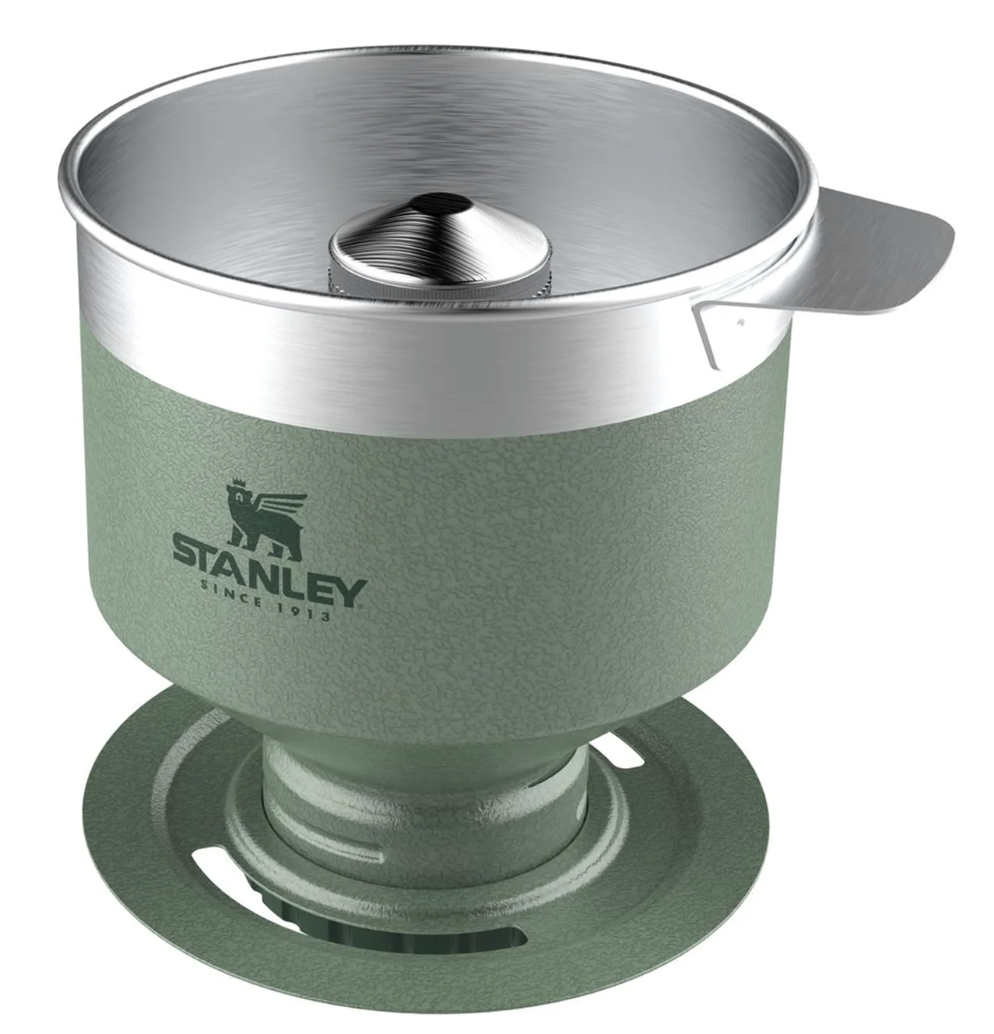
Theirishscouter was gifted a portable coffee maker by the smaller people who live in the house. Produced by the ‘Stanley’ company (of indestructible water bottle fame), it has proved ideal for brewing the perfect coffee whilst on camp. It has trekked to New Zealand and Indonesia (both in theirishscouters backyard these days) and has made perfect coffee in Borneo’s rainforests whilst on group camp, surrounded by yawning Cub Scouts. I have even taken it to hotels where machine coffee sometimes rivals instant for bitterness and lack of taste. Like the bottles, it is robust. Well worth investigating if decent ground coffee is your thing, but you also camp a lot. (theirishscouter is not being paid any fee by Stanley or anyone else. I got this as a gift and I like it/use it. Thought it would be worth sharing. That’s it!)